

Insurance Claims Support for Boarding Up in Maidstone (ME1–ME20)
If you’ve had a break-in, storm damage, vandalism or a fire incident, dealing with the insurer can feel like a second emergency. Our job is to secure the property properly and provide the practical documentation insurers typically ask for—so you can move your claim along without chasing trades for paperwork.
We provide boarding up across Maidstone and the wider ME postcode area (ME1–ME20). If you need urgent help, use our emergency boarding up service.
Need to secure the property and start your claim? Call 01622 580 086 or email us.
What we can (and can’t) do for insurance claims
Claims can vary a lot between insurers and policies, so we keep things straightforward and transparent.
What we can do
- Secure the property quickly and safely to reduce the risk of further loss (a common policy requirement).
- Provide clear evidence of works completed, including:
- time-stamped photos (before, during, after)
- a written work summary (what was secured and how)
- an itemised invoice with site address and date/time
- Explain the boarding method and materials used, e.g. 18mm exterior-grade plywood for larger window openings, or 12mm OSB where appropriate.
- Offer non-destructive fixing methods where feasible (important when glazing will be replaced soon), and explain when that isn’t possible due to damage.
What we can’t do
- We’re not loss adjusters and can’t approve claims or “authorise” repairs on an insurer’s behalf.
- We can’t guarantee what your insurer will reimburse—cover depends on your policy wording and excess.
- Fire and flood incidents sometimes need specialist remediation (smoke odour treatment, dehumidification, etc.). We secure the openings and help you document the security work, but remediation is outside our scope.
If you’re unsure what your insurer expects, we can talk you through what we’ll provide on our side—then you can relay it to your claims handler.
Why insurers often require boarding up after an incident
After a broken window, forced door, or compromised shopfront, the immediate risk isn’t just weather—it’s opportunistic entry. Most policies include an obligation to take “reasonable steps” to prevent further damage or theft.
Boarding up is typically used to:
- prevent further entry after a burglary
- keep rain and wind out after storm damage
- secure premises after vandalism or an impact
- make a building safe while glass is being measured and replaced
For incident-specific guidance, see our pages on burglary repairs, storm damage, vandalism repair and fire damage.
The documentation you’ll usually need (and what we supply)
When you’re making an insurance claim, good documentation saves time. Here’s what many customers in Maidstone and the ME area find their insurer asks for.
1) Photos and evidence of damage
If it’s safe, take photos before anything is moved or cleaned. Include:
- the damaged door/window/shopfront from multiple angles
- close-ups of lock damage, frame splits, tool marks
- wider shots showing the property and location of the opening
We also provide time-stamped photos of the secured openings once we’ve boarded up (and “during” photos where practical).
2) A clear description of what was done
Insurers often want to know exactly how the property was secured.
Our work notes typically include:
- which openings were secured (e.g. front lounge window, rear kitchen door, side alley window)
- materials used (plywood/OSB; gauge and suitability)
- fixing method (e.g. anti-tamper fixings, through-bolting where required)
- any access constraints (upper-floor windows, conservatory roof panels, restricted alley access)
If the frame is too damaged for non-destructive methods, we’ll explain the options before proceeding.
3) An itemised invoice
We provide an invoice suitable for forwarding to your insurer, usually including:
- property address and date/time attended
- labour and materials listed clearly
- notes on any additional security measures agreed (e.g. temporary steel door)
If you’re dealing with a managing agent, landlord, or facilities team, we can also send copies by email to help keep everyone aligned.
How our boarding-up work supports your claim (without overcomplicating it)
We focus on “make safe” and security, using the right method for the opening and the likely next step (glazier visit, door replacement, shopfront contractor, etc.).
Windows: securing broken glazing properly
For domestic properties around Maidstone—Victorian terraces, 1930s semis, and newer estates—the most common urgent call is a smashed pane or cracked double-glazed unit.
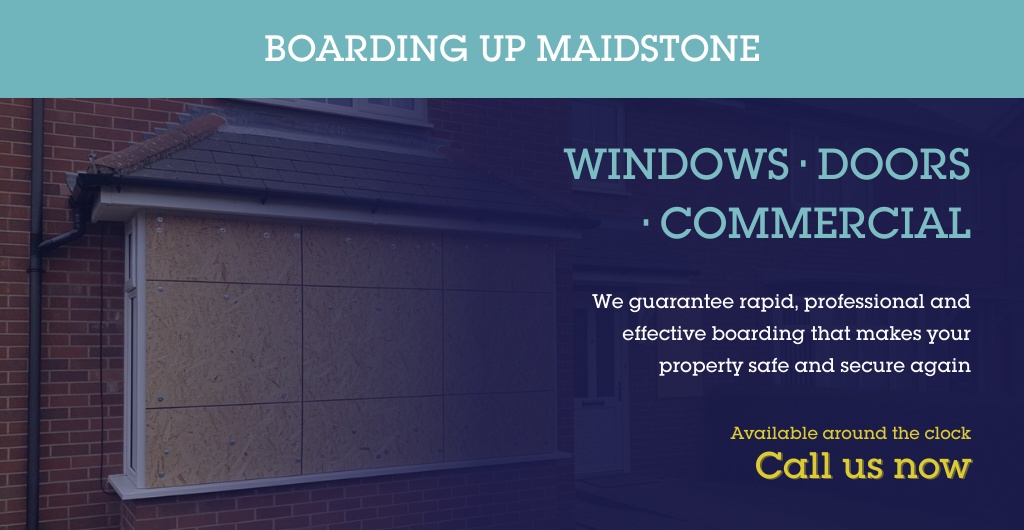
Our window boarding in Maidstone typically involves:
- measuring the aperture and selecting suitable board thickness
- fitting boards so they’re stable and resistant to removal from outside
- using fixings that balance security with minimising further frame damage
Doors: when boarding isn’t enough
After a forced entry, the door leaf and frame can be compromised. In those cases, you may need more than a sheet of timber across the opening.
Our door boarding service can include options like a temporary steel door where the property will be unattended or the door set is beyond a quick repair.
Shopfronts: keeping businesses secure between glazing visits
Maidstone has busy commercial areas—town centre units near Fremlin Walk and the streets around Week Street and Gabriel’s Hill—where a smashed shopfront creates immediate risk overnight.
Our shopfront boarding is designed for:
- larger openings and heavier footfall areas
- safe fitting methods that prioritise security and public safety
- clear documentation for insurers and landlords
Rooflights and overhead openings: weather and safety first
High winds and falling debris can damage rooflights, skylights and vulnerable roof sections—especially on flat-roof extensions and commercial buildings.
Our roof boarding focuses on safe access and temporary weatherproofing where appropriate, with a practical record of what was secured.
Step-by-step: what to do after damage (to help your claim)
- Make sure everyone is safe and call emergency services if needed.
- Report crimes to the police and keep the reference number (burglary/vandalism).
- Contact your insurer early—ask what they require for “make safe” works.
- Take photos if safe, before temporary measures are installed.
- Call us to secure the property and reduce the chance of further loss.
- Keep all documentation together (photos, police ref, insurer emails, invoices).
If you need immediate help, go straight to emergency boarding up or call us now.
Working with landlords, managing agents and facilities teams
We regularly attend properties where:
- tenants have had a break-in and the landlord needs security fast
- an estate agent requires the property secured between viewings
- a facilities manager needs a clear paper trail for internal approvals
If you’re arranging works on behalf of someone else, it helps to confirm:
- who is authorising the works (name and contact number)
- where access will be (keysafe, neighbour, on-site security, etc.)
- whether there are any site rules (shopping parade, school, office building)
For more on suitability by property type, see residential boarding up, commercial boarding up and vacant property security.
Cost and approval: how to avoid claim delays
We don’t publish fixed prices because boarding up costs depend on the opening size, access, material choice, and fixing method. Insurers also handle approvals differently—some ask you to proceed and submit invoices; others want pre-approval.
If you’re unsure, you can:
- call your insurer and ask whether “reasonable make-safe works” are covered
- ask if they need photos and a written description (we can help supply these)
- confirm whether your excess applies to the incident
For a clear breakdown of what affects cost, see pricing.
FAQs about insurance claims and boarding up in Maidstone
Is boarding up covered by insurance in Maidstone?
Often it is, but it depends on your policy and the incident type. Many policies cover necessary “make safe” work after burglary, vandalism or storm damage, but your excess and policy conditions still apply. We provide documentation that insurers commonly request.
Should I call my insurer before I arrange boarding up?
If you can do so without leaving the property vulnerable, yes. But if the opening is exposed (especially overnight or on a busy street), securing it quickly is usually the priority. You can then notify the insurer with photos and the invoice.
What details should be on the invoice for my claim?
Insurers typically want the property address, date/time of attendance, a description of what was secured, and an itemised breakdown of labour/materials. That’s how we format our paperwork.
Can you send paperwork directly to my insurer or managing agent?
Yes—we can email invoices and supporting photos to you, your agent, or your insurer’s nominated contact. We’ll always confirm where you want documents sent.
I’m in a village outside Maidstone—do you still cover my postcode?
Yes. We cover Maidstone and the ME postcode area (ME1–ME20). If you’re unsure, check areas we cover or call us.
Why local knowledge helps during a claim
When you’re stressed, you don’t want confusion about access, parking, or location details. We work across Maidstone—from routes around the M20 junctions to town-centre callouts where loading restrictions and footfall matter—and we’re used to securing a mix of period homes, newer estates, and commercial premises.
If you need help, we’ll ask the practical questions upfront (what’s damaged, whether anyone is inside, whether police are attending, and any access constraints) and then focus on getting the building secure and documented.
Helpful links
- 24-hour emergency boarding up in Maidstone
- Pricing and what affects the cost
- Burglary repairs and post-burglary boarding
- Window boarding in Maidstone
- Door boarding and temporary security options
- Contact our Maidstone team
Ready to get started? Call 01622 580 086 or email us for a free, no-obligation quote.
